Now Available · Instant Access · For Parents of Kids 5 to 12
The counterintuitive 30-day fix that turns bedtime battles into deep sleep.
Simply follow each day's 5-minute action to finally understand the “sleep rhythm” keeping your child up, and reset it so they wind down on their own every night.
£37 · One-Time · Instant Access
Whole household · Delivered by email · Instant access
The 30-Day Sleep Reset · By Alexander Mulhall
★★★★★ · Built on 11 years of clinical family practice · Delivered instantly
✷ Even If You Don't Buy
Why Nothing Has Worked So Far
A note from Alexander Mulhall
Over eleven years of clinical practice with families, I've realised nearly all sleep advice for school-age children is aimed at the wrong problem entirely.
Parents arrive knowing what's supposed to work. They've read the books. They've saved the Instagram posts. They maybe can even show awareness of circadian basics, think blue light, timing and melatonin release. Some can quote sleep hygiene checklists better than most doctors.
Then they come back three months later with the exact same problems.
The mum sitting across from me is exhausted. Bedtime battles. Night wakings. Children who wake up unrested. She knows what should work. None of it has stuck.
What I found across those eleven years wasn't that parents don't have enough information. Often, they have so much of it that it becomes overwhelming and even contradictory. The answer you've been looking for is more straightforward than you might think.
* * *
My practice started with neurodevelopmental work. Neuro-stimulation therapy for children whose bodies weren't yet doing what they needed to do. The therapy often created real change in the child. But the parents? Sometimes they couldn't even see the transformation happening in front of them.
That's when I realised I needed to work with the whole family, not just the child.
One mother told me everything in their home was carefully thought through. Awareness of what they ate. Awareness of the light in the house. Clear rules, but real openness to discuss. Her children were remarkable. Grounded. Articulate. And they slept.
She saw the pattern before I did. Her home was doing the work her willpower didn't have to.
I started looking at my own life as someone who could be classed as somewhat neurodivergent. My successes hadn't come from motivation or discipline alone. They came from designing my environment. When I took the junk food out of my house, I stopped needing discipline. The house made the right choice the easy one. When I recognised how much light and the seasons affected me, in my early years long before any popular focus on it, I stopped trying to tough it out. I built my surroundings to work with my body.
Not discipline. Not willpower. Learning to work with the things that shape us.
* * *
You're probably thinking, “that sounds far too obvious and simple to actually fix what we've been dealing with.” And it's true, it is incredibly straightforward. But knowing that environment design matters and actually having a system that works for your family are two completely different things.
Picture the moment. You've slept four hours in two days. Your partner forgot the coffee. Again. Your boss is chasing you. Your child is melting down because the sandwich is cut wrong.
You're on autopilot. You fall back on how your own parents handled things. You may have saved fifteen posts about staying patient. You may have listened to that podcast in five-minute stretches between school runs. Under that much stress, none of it surfaces.
Your surroundings and your body's state run your response. The information in your head doesn't get a look in.
This is why the bedtime routine isn't working. You're not doing it wrong. A routine at 9pm is a piece of information handed to a child whose nervous system has already spent six to twelve hours being told, by everything around it, to stay switched on.
Research shows ordinary indoor lighting suppresses a child's sleep hormone almost twice as hard as it does an adult's. Even dim light, the kind you'd barely register, suppresses melatonin by 78% in young children before bed. It stays suppressed for nearly an hour after the lights go off.
The real problem is a mismatch between how your home is set up and how your child's body actually works. That's why the routine and the melatonin keep falling short.
* * *
Here's what does work.
You stop trying to force bedtime. You go upstream. You rebuild the six to twelve hours before bed so that everything reaching your child's nervous system across the day points, by evening, toward slowing down.
You do it by changing what surrounds them across the day.
I call this a "circadian reset." It runs on three levers. Light: morning sunlight to set the clock, less light in the evening to let it wind down. Schedule: real gaps built into the day so the nervous system has time to decelerate before it's asked to sleep. Surroundings: the sensory conditions, meal timing, and screen habits that let sleep actually happen.
A "circadian reset" is a redesign of the whole day, the system that makes bedtime work on its own. Once the day is right, the routine you've already been running tends to start working. The routine was never the problem. The day around it was.
* * *
Even if you never buy anything on this page, sit with the question that changes how you see your child's sleep from tonight:
Between 3pm and bedtime, what is my child's nervous system taking in, and is any of it telling their body to slow down?
Answer that honestly and you'll understand more about why nothing has worked than any parenting article has told you.
The Mechanism
The Three Levers
That Reset The Day
✷ Every school-age sleep problem responds to some mix of these three
1
Light
Morning sunlight sets your child's body clock at the right time. Less light in the evening lets melatonin arrive when it should. Handled properly, this one lever clears a real share of school-age sleep trouble on its own.
2
Schedule
Consistency and awareness is key here. A child whose day never lets up cannot arrive at bedtime in a state that allows sleep.
3
Surroundings
The sensory conditions, the meal timing, and the space itself, all set up so sleep can happen. This goes well past "make the room dark." It runs from screen habits to when dinner lands to how the evening actually ends.
Line these three up on your child's rhythm and the body does the rest. You stop trying to make bedtime happen. It happens.
Start The 30-Day
Sleep Reset Tonight
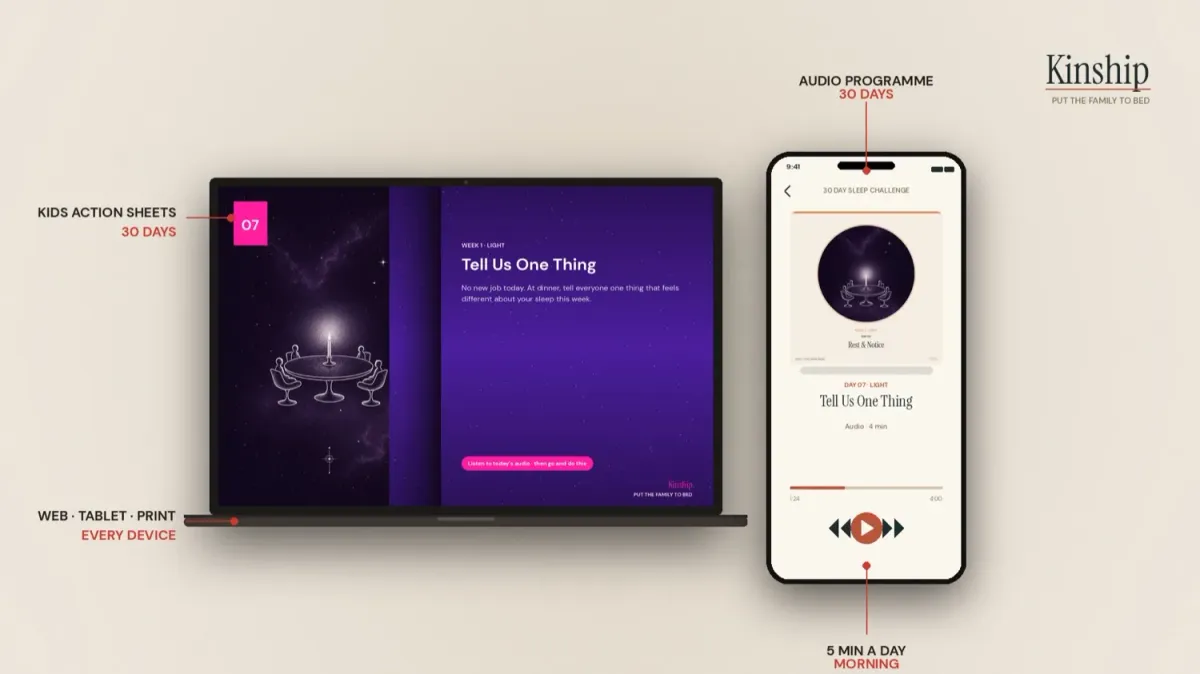
The full 30-Day Sleep Reset (daily lessons, protocols for each rhythm, Science PDF, audio guidance)
Access to the 6 Sleep Rhythms diagnostic
Instant access · Whole household · Lifetime
£37 One-Time
Secured checkout · Delivered immediately
The Practitioner
What Eleven Years Of
Clinical Practice Revealed
I'm Alexander Mulhall. For over a decade I've worked with families, and one foundation of that is children's health and sleep. The pattern that showed up across thousands of families was not one that another symptomatic response could sort.
Every "bad sleeper" fell into one of six recognisable rhythms.
The families who turned their child's sleep around fastest weren't the ones with the strictest routines. They were the ones who stopped treating bedtime as the fix and started learning more about the body's physiology and the process of sleep. Once the day was set up right, bedtime sorted itself out, often inside the first week.

Alexander Mulhall
Founder, Kinship Way · 11 years in clinical family practice
Up to 50% of school-age children in the U.S. don't get enough sleep.
CDC
Chronic sleep deprivation in pre-teens shows measurable changes in brain regions responsible for attention, memory, and emotional regulation.
NIH
Sleep-deprived children show symptoms often misdiagnosed as ADHD.
Journal of Pediatrics
Poor sleep in childhood is a strong predictor of anxiety and depression in adolescence.
Stanford Medicine
Fix The Day. The Night Follows.
The full 30-Day Sleep Reset (daily lessons, protocols for each rhythm, Science PDF, audio guidance)
Access to the 6 Sleep Rhythms diagnostic
Instant access · Whole household · Lifetime
£37 One-Time
Secured checkout · Delivered immediately
Proof
Real Parents. Real School
Nights. Real Sleep.
01
“By Day 10 our seven-year-old was asking when the candle dinner was happening again. By Day 30 phones live in the kitchen and nobody fights about it. I don't know how that happened.”
— Sarah · Two kids · Bristol
★★★★★
02
“The bin bags on the windows felt ridiculous. Then our nine-year-old slept through the night for the first time in months. I'm not taking them down.”
— David · Three kids · Manchester
★★★★★
03
“It's the first sleep thing that asked me to change my own habits, not just my kids'. That's why it actually stuck.”
— Priya · One teen · London
★★★★★
Start Tonight
£37
One-time. Lifetime access. No subscription.
Instant Download · Delivered By Email
The 30-Day Sleep Reset (daily lessons, per-rhythm protocols, Science PDF, audio guidance)
The 6 Sleep Rhythms diagnostic access
Whole-household access
Lifetime access to all materials
Secured by 256-bit encryption
Questions.
The Ones Parents Actually Ask.
What exactly am I paying for?
The full 30-Day Sleep Reset, delivered by daily email, plus the 6 Sleep Rhythms diagnostic. All digital. Lifetime access. One-time payment.
I've already tried a bedtime routine. Why would this be different?
A bedtime routine works on the last 30 minutes of the day. The reset works on the six to twelve hours before that, the part that actually decides how your child sleeps. Get the day right and the routine you already have tends to start working on its own. The routine was never the problem.
Do I need to give up melatonin?
No. But most parents who try melatonin find it stops working, or never worked at all. Low melatonin is rarely the real issue. The timing of melatonin is, and that timing is set by light exposure across the day. The reset fixes the timing. After that, melatonin becomes optional.
My kids are different ages. Does the same system work for all of them?
The framework works across all of them. The specific adjustments differ by rhythm. If two of your children are in different rhythms, you run the same daily structure for each, tuned to where they are. It's built for the whole household from the start.
My child has ADHD, anxiety, or sensory processing challenges. Will this work for them?
Yes, and often more visibly than for neurotypical children. The protocols map to the underlying physiology. Children with ADHD, anxiety, or sensory processing challenges often have sharper disruption in one of the three levers, so the right change tends to show a bigger difference. This is not a medical treatment. It sits alongside any care your child is already receiving.
Can I trust the person behind this?
Alexander Mulhall has spent over a decade in clinical work with families on children's health and sleep. The six sleep rhythms and the "circadian reset" method came out of that work. This is not repackaged sleep-training advice.
How is it delivered?
Instant digital access after checkout. Daily lessons arrive by email for 30 days. Everything is yours to keep and revisit. No app to download.
What if I don't have time to start right now?
The materials wait for you. Start whenever you can, and the delivery runs at your own pace.